

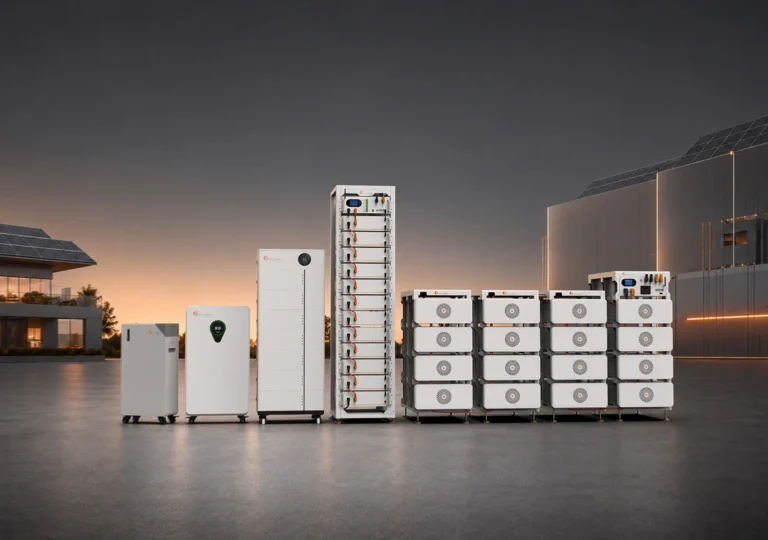
There are three main types of residential solar systems in common use today: grid-tied, off-grid, and hybrid. What differentiates them is how they interact with the utility grid and how they manage electricity.
A grid-connected system suits homes with a reliable utility supply: solar power is used directly during the day, lowering the electricity bill. Homeowners who want to operate independently of the grid — or who have no grid access at all — need an off-grid system. A hybrid system sits between the two.
Improvements in panel efficiency, LiFePO4 batteries, and app-based monitoring have turned home solar from a simple generation setup into a complete energy system that generates, stores, manages, and reports.
What Are the Different Types of Residential Solar Systems?
| System Type | How It Works | Main Advantages | Typical Applications |
| Grid-Tied Solar System | Connects solar generation to the utility grid | Lower initial investment, simple operation | Urban and suburban homes with a reliable grid |
| Off-Grid Solar System | Runs on solar panels and batteries, independently of the grid | Energy independence, stable supply where there is no grid | Remote areas and locations without grid access |
| Hybrid Solar System | Combines solar, battery storage, and grid interaction | Flexible energy use plus backup capability | Homes with higher consumption or an unreliable grid |
1. Grid-Tied Residential Solar System
The grid-tied system is the most common residential solar configuration. Panels convert sunlight into DC electricity, and an inverter converts that DC into the AC electricity used at home.
During the day, solar power runs lights, refrigerators, air conditioners, televisions, and other appliances directly. If generation exceeds household consumption, the surplus may be exported to the utility grid, where local regulations and tariff arrangements permit.
The main advantages of a grid-tied system are:
- Lower electricity costs— daytime loads are served directly by solar, reducing grid purchases
- Simple installation and maintenance— fewer components than a storage-based system
- Efficient use of solar generation— energy is consumed at the point of production
There is one important limitation. A conventional grid-tied solar system cannot supply power during a blackout because it is required to shut down and disconnect from the grid for safety reasons — a protection known as anti-islanding, which prevents electricity from feeding back into lines that utility crews may be working on. Homeowners who need backup power during outages must add battery storage or choose a hybrid configuration.
2. Off-Grid Residential Solar System
An off-grid home solar system suits sites with limited or no grid access, and homeowners who want full control over how their electricity is produced and stored.
The system uses solar panels, an off-grid inverter, and a battery bank. During the day, panels generate electricity that runs household loads directly; surplus generation charges the battery, which then supplies the home after sunset or during extended cloudy periods.
A complete off-grid solar system generally includes:
| Main Component | Function |
| Solar panel | Converts sunlight into DC electricity |
| Off-grid inverter | Converts DC from panels and battery into AC for household loads, and manages solar and utility/generator charging (MPPT built in) |
| Lithium battery | Stores energy for later use |
| Fsolar monitoring | Tracks generation, consumption, battery status, and alarms via web or app |
How Energy Storage Improves Off-Grid Performance
Storage is what makes a stand-alone solar system practical. It lets a household use its own solar generation after dark, reducing dependence on the grid or a diesel generator.
Felicity Solar’s off-grid range covers this configuration directly. The IVEM8048-II is an 8 kW single-phase off-grid inverter that combines a pure sine wave inverter, an MPPT solar charger and a battery charger in one unit, with a peak efficiency of 94.5% and parallel capability up to six units. Paired with a FLA48300 15 kWh LiFePO4 battery (51.2 V, ≥6,000 cycles, expandable to 225 kWh with up to 15 units in parallel), it forms a practical residential off-grid system.
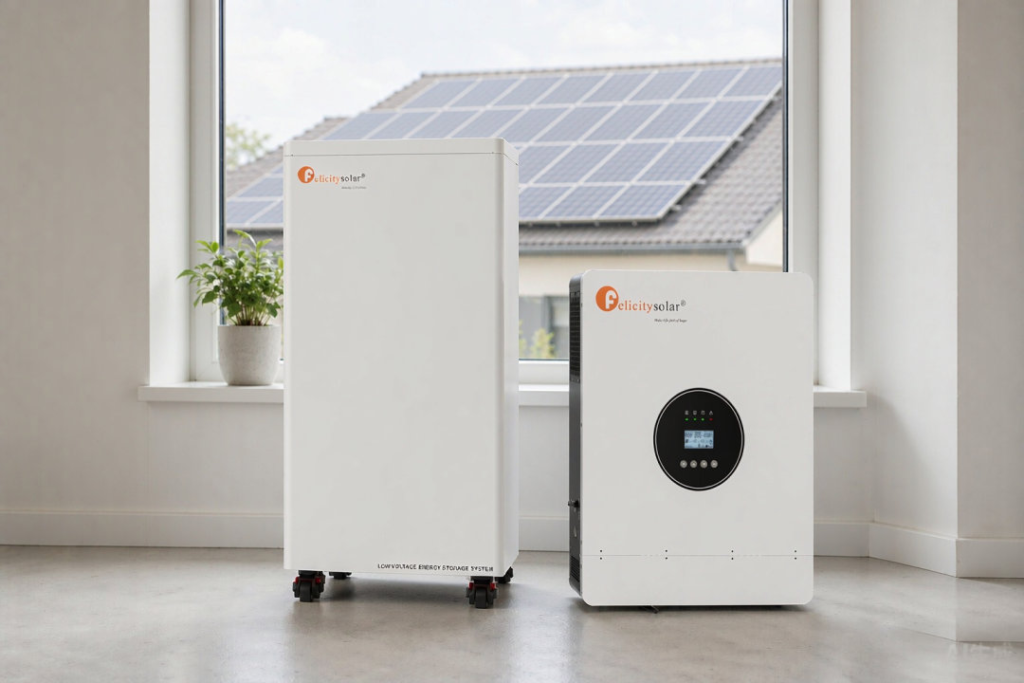
This configuration is designed for self-generation and self-consumption:
- Solar energy powers household appliances directly during the day
- Surplus generation charges the 15 kWh LiFePO4 battery
- Stored energy supplies household loads after sunset or during extended cloudy periods, for as long as battery capacity allows
- Where a utility or generator supply exists, the inverter can also charge the battery from AC, and switches to backup output in around 10 ms in UPS mode
3. Hybrid Residential Solar System
A hybrid residential system combines the two operating modes described above: it works with the grid like a grid-tied system, but also stores energy and can keep essential loads running like an off-grid system. The controller switches automatically between sources based on solar generation, battery state of charge, and household demand.
Under normal conditions, solar generation covers the household load first, and any surplus charges the battery. Depending on configuration, further surplus may be exported to the grid.
The main benefits of a hybrid system are:
- Higher energy independence— stored solar energy is available when generation drops
- Backup power capability— essential appliances continue running during outages
- Flexible expansion— additional battery modules can be added in parallel as needs grow, up to 15 units (225 kWh) with the FLA48300, for example
Felicity Solar’s IVGM series covers this category, with hybrid inverter platforms from 3 kW to 125 kW, including the single-phase IVGM5~8KLP2G1 for residential use.
How to Choose the Right Residential Solar System
Choosing the right system requires a careful look at household consumption, local conditions, and future requirements.
Household Electricity Consumption
System size follows daily consumption. As a rough guide:
- A small off-grid home or cabin typically uses 3–5 kWh per day
- A larger household with air conditioning, water pumps, and multiple appliances may need 20 kWh or more per day
- Homes with a home office, EV charger or extensive automation sit at the upper end of that range
An accurate load list — appliance ratings, daily operating hours and future additions — is the starting point for sizing the array, the battery and the inverter.
Local Solar Conditions
Solar irradiation at the installation site determines how well the system performs. Sites with higher solar irradiation generate more energy from the same array size, so the system can be smaller for a given daily consumption. Most locations receive roughly three to six peak sun hours per day; the sizing calculation should use the lowest seasonal figure rather than the annual average, so the system still works in winter or during cloudy periods.
Shading, roof orientation and tilt angle all affect the result and should be assessed before finalising the design.
Future Energy Requirements
Consumption rarely stays flat. Scalability leaves room for future loads — an EV charger, home automation or additional appliances — without replacing the core system. When comparing options, check the maximum number of battery modules that can be connected in parallel and whether the inverter can be paralleled or upgraded later.
Conclusion
Felicity Solar has been building solar and energy storage products since 2007, and today supplies off-grid inverters, hybrid inverters, LiFePO4 battery packs, all-in-one energy storage systems, and commercial and industrial storage to customers in more than 100 countries.
If you are planning a residential solar system and want help choosing between grid-tied, off-grid and hybrid configurations — or sizing the array, inverter and battery for your specific load — contact Felicity Solar. Our technical team can review your consumption data and recommend a configuration, and the online system configuration tool lets you model options yourself.
FAQ
What is the difference between grid-tied, off-grid and hybrid solar systems?
A grid-tied system connects directly to the utility grid and has no battery, so it is the cheapest option but provides no power during a blackout. An off-grid system runs entirely on solar and batteries, independent of the grid. A hybrid system does both: it works with the grid and stores energy for backup and self-consumption.
What can an 8 kW off-grid inverter with a 15 kWh lithium battery power?
A configuration such as the Felicity Solar IVEM8048-II with a FLA48300 15 kWh battery suits a household running refrigerators, lighting, televisions, computers, water pumps and air conditioning for part of the day. Exact capability depends on the total connected load, surge currents from motor-driven appliances and how many hours of autonomy are needed after sunset.
Can an off-grid system provide backup power when the grid is unavailable?
Yes, if the inverter supports AC input. Although the IVEM series is classified as an off-grid inverter, it accepts utility or generator power for battery charging and offers a UPS mode with a transfer time of around 10 ms, so it can also serve homes on a weak or unstable grid. A pure grid-tied system without storage cannot do this.
Can the system be expanded as energy demand grows?
Yes. The FLA48300 battery supports parallel connection of up to 15 units for a total of 225 kWh, and the IVEM8048-II supports parallel operation of up to six units. Expansion limits vary by model, so the specification sheet for the specific unit should always be checked before planning future growth.
What applications does this type of residential solar system suit?
Beyond permanent homes and villas, an 8 kW off-grid configuration is commonly used in stores, small warehouses, schools, clinics, and rural sites without reliable grid access, and EV charging.
How do users monitor the system?
Through the Fsolar platform. Users can view solar generation, electricity consumption and battery status in real time on web or mobile app, and receive instant fault notifications. Historical data can also be exported for energy management and analysis.


